
🌐 Langue : 🇪🇸 Español · 🇬🇧 English · 🇫🇷 Français
Discovering what to see in Teruel is a constant delight. Few cities pack so much beauty into such a small space without ever shouting about it. Teruel doesn’t overwhelm you: it wins you over, one tower and one square at a time, through sunlight glinting off glazed ceramics and a remarkable heritage that makes you stop and look around at every turn.
Forty-eight hours can go a long way when the city itself has a soul and the entire historic centre is within easy walking distance. You can stroll from one end to the other in just a few minutes, taking in everything from soaring Mudéjar towers to the prehistoric giants of Dinópolis. Just start exploring. Teruel will do the rest.
How to Plan Your Visit Without Rushing or Sticking to a Rigid Schedule
Although this guide is designed around two full days, there’s no need to tie yourself to a fixed itinerary. Teruel’s historic centre is wonderfully easy to explore on foot, at any time of day. However, if Dinópolis is part of your plans, allow anything from half a day to a full day, depending on the tickets you choose. It’s worth booking in advance and fitting your sightseeing around your visit, either before or afterwards.
Whether you’re drawn to Teruel by the magic of its Mudéjar architecture, intrigued by its famous reputation as the City of Love, travelling with friends or bringing the family along in search of dinosaurs, here is what to see in Teruel, arranged so you can combine the sights however you like.
And if you decide to start right in the heart of the city, there’s no better place to begin than by stepping inside its most iconic tower, discovering its hidden secrets and admiring the medieval city layout from above.
View the Full Route Itinerary
🧭Route Contents
1. El Salvador Tower: Your Gateway to Mudéjar Architecture and the Perfect Starting Point in Teruel
If Teruel were a book about history and art, El Salvador Tower would be its essential opening chapter. Most visitors start their exploration at Plaza del Torico or the Mausoleum of the Lovers of Teruel. That’s the usual approach, but if you ask us for a local recommendation, we’d suggest starting here instead.
There’s a very good reason to visit this tower first: inside, you’ll find the Interpretation Centre of Teruel’s Mudéjar Architecture, dedicated to a remarkable architectural tradition found nowhere else quite like this. Mudéjar architecture is at the very heart of Teruel’s identity and one of the reasons its monuments were recognised as a UNESCO World Heritage Site. Exploring the tower’s interior gives you all the background you need to understand this extraordinary art form. You’ll then see the rest of the city with completely different eyes.
One more tip: try to visit early in the morning or later in the afternoon. It’s usually quieter, and the light filtering through the paired arches of the bell tower is simply stunning.

Five Reasons Why El Salvador Tower Should Be Your First Stop in Teruel
1. The origins of Teruel – a meeting point of three cultures: Teruel was founded during the medieval Christian reconquest, and its identity was shaped by the coexistence of Christians, Muslims and Jews. Out of this cultural encounter emerged Mudéjar art: Christian architectural structures and building techniques enriched with the extraordinary craftsmanship and decorative traditions of Islamic artisans. Here, you’ll understand this fascinating meeting of cultures before setting off to explore the rest of the historic centre.

2. The Alarife Room – your medieval building masterclass: Before you even start climbing, your visit begins on the ground floor, where you’ll find the Alarife Room.
This audiovisual space brings a medieval master builder to life, welcoming you in person and revealing the secrets behind the construction of the tower. Through a unique immersive presentation, you’ll discover the techniques used by medieval builders and learn how to interpret the symbolism of the brickwork and glazed ceramic decoration.
Here’s a little preview of what’s waiting for you before you begin your ascent:
3. A tower within a tower – an ingenious architectural solution: As you begin climbing, you’ll discover one of the tower’s best-kept secrets: it’s not a solid structure, but rather an inner plaster-and-masonry tower enclosed within a second, outer brick tower, in a design reminiscent of Almohad minarets. Walking through the space between the two walls, beneath the remarkable interlocking vaults, is quite an experience.
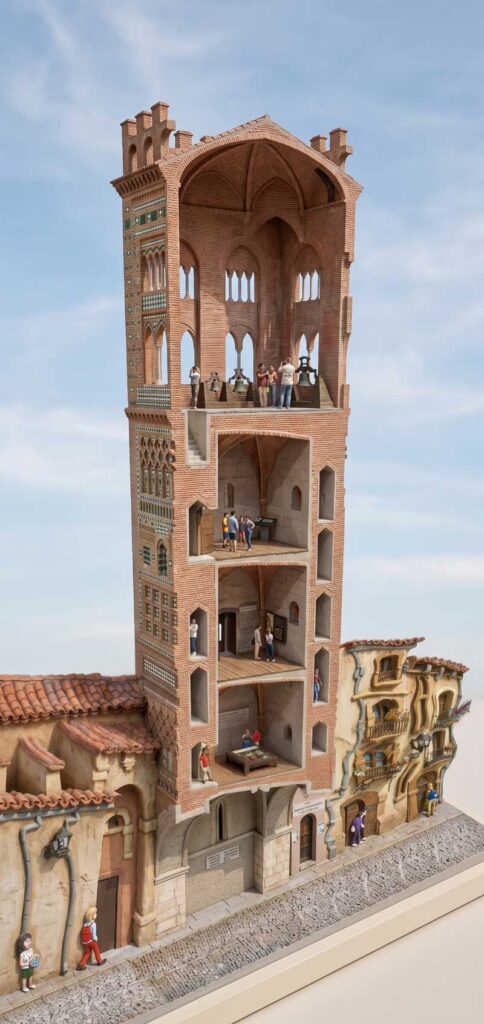
4. Three exhibition rooms and a living bell tower: Don’t let the 122 steps put you off. Bear in mind that this is a historic monument without a lift, but the climb is broken up into stages, making it much less demanding than you might expect. Along the way, you’ll discover three exhibition rooms, one above the other, with information panels in five languages and audio guides accessible via QR codes. The highlight of the uppermost room is a scale model showing what medieval Teruel looked like in the 14th century, when the city was still surrounded by its defensive walls. But the real treat comes at the very top. At a height of 40 metres, you emerge into a working bell tower, where the bells still mark the rhythm of city life, just as they did in the Middle Ages. And the views are unbeatable: a breathtaking 360-degree panorama across the rooftops of the historic centre, the Cathedral and the city’s other Mudéjar towers, stretching out towards the green Turia valley. For us, it’s undoubtedly the best postcard-perfect view of Teruel – and the perfect place for a memorable selfie!
5. The legend that explains it all: Did you know that Teruel’s famous towers are linked to a story of rivalry and love? Inside our tower, you’ll discover the legend of Zoraida and the master builders who competed to construct the most beautiful tower. Starting your visit with this story is a wonderful way to get under the skin of Teruel, the City of Love.
👉 Check the latest opening times, admission prices and tickets for El Salvador Tower here.
An Important Thing to Know About Teruel’s Mudéjar Towers
Teruel has four major Mudéjar towers, but only two are open to visitors wishing to explore their interiors: El Salvador and San Pedro (the latter managed by the Fundación Amantes). Both are unmissable architectural gems, although they offer very different experiences. San Pedro Tower is the older of the two, dating from the 13th century, and retains a more intimate, enclosed atmosphere, with its winding spiral staircase.
El Salvador, on the other hand, is one of the great architectural landmarks of the 14th century and the tallest of the city’s historic towers. Its remarkable double-tower structure makes the interior particularly spacious and comfortable to explore. It also houses the Mudéjar Interpretation Centre and offers the highest and most open panoramic views across the Turia valley. Ideally, you should visit both. But if you’re after the ultimate panoramic view and want to gain a deeper understanding of Mudéjar architecture, El Salvador is the star attraction.

💡 A visual tip: This reconstruction from our audiovisual presentation offers a wonderful illustration of how Mudéjar architecture evolved. The two towers on the left (the Cathedral and San Pedro) date from the 13th century and display an earlier, more restrained style. The two on the right (San Martín and El Salvador), built in the 14th century, showcase the decoration, height and grandeur of Mudéjar architecture at its finest.
⛪ And Right Next to the Tower… El Salvador Church
You can’t finish your visit to our tower without stepping inside El Salvador Church, the building to which it is attached and whose bell tower is, in fact, the Mudéjar tower itself. Although the original medieval church was badly damaged by a fire in the 17th century, the building you see today is the magnificent Baroque reconstruction erected in its place, in keeping with the artistic tastes of the time.
It’s a beautiful, welcoming and wonderfully light-filled church. Its main altar houses one of the most cherished and venerated religious images in Teruel: the Christ of the Three Hands (Cristo de las Tres Manos), an object of great popular devotion.

ℹ️ Practical visiting tip:
Admission to the church is completely free. You can visit independently during its opening hours for visitors and religious services, which also include confession times.
Just remember to plan your visit around Mass times if you’d prefer to explore the church without interrupting a service.
👉 Check El Salvador Church’s opening hours here.
2. Teruel Cathedral: The Sistine Chapel of Mudéjar Art
If there’s one place you absolutely must visit during your stay in Teruel, it’s the Cathedral of Santa María de Mediavilla. Its 13th-century Mudéjar wooden ceiling is truly unique in the world. Meticulously constructed and painted, this extraordinary masterpiece is like an illustrated history book, offering a fascinating visual record of medieval society. Look up and you’ll see an entire world unfolding above you: kings, knights, members of the clergy, craftsmen, peasants and even fantastical creatures. It’s an extraordinary snapshot of medieval life.


ℹ️ A tip for visitors: You can admire the ceiling from the main nave, looking up from ground level. However, the best way to appreciate its beauty – and really make out all its intricate details – is from the elevated galleries immediately below it. To access this privileged viewpoint, you’ll need to book the Cathedral’s guided tour, as these galleries are not included in the standard self-guided visit. Trust us, it’s well worth it!
Beyond its extraordinary ceiling, the Cathedral’s interior holds several other treasures:
- A magnificent Renaissance high altarpiece carved from wood, remarkable for retaining the natural colour of its pine rather than being covered in gold.
- A spectacular Gothic wrought-iron choir screen.
- The Chapel of the Immaculate Conception, decorated with Baroque frescoes.
- The impressive Mudéjar dome over the crossing, which floods the altar area with light.
Its Mudéjar tower deserves a special mention, too. Dating from the 13th century, it is a full century older than our beloved El Salvador Tower. Unlike El Salvador, with its complex double-tower structure, the Cathedral’s tower has a simpler layout. Unfortunately, it’s not currently open to visitors because its narrow bell chamber is packed with bells and structural beams, leaving very little room to move around.
For me, one of the most photogenic spots is actually outside the Cathedral. From Plaza de la Catedral (also known as Plaza del Ayuntamiento), you can capture a perfect architectural alignment: the Mudéjar tower, the dome above the crossing and the striking Neo-Mudéjar entrance. It’s an essential photo opportunity both during the day and at night, when the lighting brings out every architectural detail. Bring your camera – and make sure you take the shot at both times!
⛪ Practical information and religious services:
The Cathedral continues to hold regular Mass services:
- Monday to Saturday: 10:00 am.
- Sundays and public holidays: 12:00 noon.
Bear this in mind when planning your visit if you’d prefer to explore outside service times.
⚠️Word of warning about Saturday afternoons: From May to October, weddings are quite common, so tourist access and the peaceful atmosphere of your visit may be affected.
👉 Check Cathedral admission prices, guided tours and opening hours here.
🎨 An Extra Visit Included: The Museum of Sacred Art
One detail many visitors overlook is that your Cathedral admission ticket also includes access to the Museum of Sacred Art, located right next door in the historic Episcopal Palace.
It’s well worth a visit. Its galleries house a valuable collection of medieval sculpture, Flemish panel paintings and religious silverware dating from the 14th to the 18th centuries, offering a fascinating insight into Teruel’s religious heritage over the centuries. Exploring the rooms of this 16th-century palace and taking a look into its inner courtyard is also the perfect way to round off your visit before heading back outside.

3. San Martín Tower: A Pleasant Stroll and the Perfect Photo Opportunity
After immersing yourself in the art and history inside the Cathedral, it’s time to get some fresh air and enjoy Teruel’s outdoor sights.
Take a leisurely walk towards Plaza del Seminario and discover San Martín Tower.
Let’s make one thing clear from the outset: this tower isn’t open to visitors inside. Neither is its adjoining church, which is no longer used for worship and now serves as a storage space for the religious floats used in Teruel’s Holy Week processions. But the walk is more than worth it. Standing on its own, with no neighbouring buildings blocking the view – quite unusual considering that it was originally built as a tower-gateway – San Martín offers one of the widest, prettiest and clearest views of the historic centre.
Take a little break here and enjoy the surroundings. The imposing building directly opposite is the former Seminary. Although it no longer serves as a seminary, it now houses a residence and various offices belonging to the Diocese. Here’s an interesting historical detail to keep in mind as you wander around: this area was once home to Teruel’s medieval Moorish quarter, although unfortunately none of it has survived.

There are two interesting details to look out for as you approach:
- The leaning tower: If you walk along Calle Amantes from the Town Hall, keep your eyes on the tower as you get closer and compare it with the neighbouring façades. You’ll notice that it leans slightly to one side.
- The tragic legend of the master builder: Like our beloved El Salvador Tower, San Martín dates from the 14th century and shares the distinctive tower-gateway design. According to legend, this was where the master builder Omar threw himself to his death after discovering, in despair, that his tower had ended up leaning.
👉 Read the full legend of Teruel’s Mudéjar Towers: Omar, Abdalá and Zoraida.
4. San Pedro Church and Monumental Complex: Where Mudéjar Architecture Embraces Love
If you ask me where art and emotion come together most intimately in Teruel, my answer is undoubtedly here. Most visitors come to this part of the city drawn by the famous love story of Isabel de Segura and Diego de Marcilla, the legendary Lovers of Teruel. But put the Mausoleum to one side for a moment, and I promise that San Pedro Church will surprise you in its own right, thanks to its extraordinary architecture and colours. Both the church and its tower have been recognised as UNESCO World Heritage Sites.

What Not to Miss During Your Visit:
- The spectacular explosion of colour inside the church: When I first walked through its doors, I was expecting a fairly traditional medieval church. What I found was quite the opposite. Although its original structure dates from the 14th century and combines Gothic and Mudéjar elements, the local artist Salvador Gisbert transformed the interior towards the end of the 19th century, giving it a spectacular Neo-Gothic and Art Nouveau makeover. The richness of its colours, gilded details and paintings covering the walls and vaults creates an immersive, almost theatrical atmosphere that feels completely different from anything else you’ll see in the city.
- A Mudéjar cloister to wander through Attached to the church, you’ll find its beautiful cloister. Although it was remodelled with Neo-Gothic touches in the 19th century, it’s a remarkable piece of heritage in its own right: one of only four surviving cloisters of Mudéjar origin in the whole of Aragon. It’s a wonderfully atmospheric little corner, perfect for a quiet moment away from the crowds.
- Exploring the tower and walking along the elevated passageway: San Pedro Tower, dating from the 13th century, is the oldest of Teruel’s towers and has a more intimate character. The ascent takes you up a wooden spiral staircase leading directly to the ándito, an elevated passageway running above the apse of the church. The real highlight here isn’t the search for panoramic views outside, but the unusual experience of walking around the upper interior of the church and seeing the details of its stained-glass windows and vaults from remarkably close quarters. It’s an interesting elevated perspective before you complete your visit.

🏛️ The Mausoleum and the Fundación Amantes
The Mausoleum building serves as the visitor reception centre for the entire complex and is where you can purchase the different admission tickets. Inside, you’ll find the famous alabaster sculptures of Isabel and Diego by Juan de Ávalos, alongside exhibition spaces that explore the historical context of their 13th-century story and its enduring significance.
The Fundación Amantes also deserves special recognition. As well as managing this remarkable monumental complex, it acts as a genuine driving force behind Teruel’s cultural life, organising concerts, lecture series and exhibitions throughout the year.

⛪ A Practical Tip for Your Visit
💡 Different admission options
At the ticket office or on the official website, you can choose between individual tickets and a combined admission ticket.
If you want to enjoy the complete experience and see the church from every angle, the best option is the ticket that includes the church, cloister, tower and elevated passageway, and Mausoleum.
Beyond Mudéjar Architecture: More Must-See Sights in Teruel
Mudéjar art is the soul of the city, but limiting yourself to its towers would mean missing out on half the story. Teruel has plenty of other wonderful surprises to round off a perfect weekend.
5. Teruel Museum (Provincial Museum): A Wonderful Cultural Surprise
If I had to recommend just one non-Mudéjar attraction without hesitation, this would be it.
Housed in the Casa de la Comunidad, a beautiful 16th-century Renaissance palace with an impressive stone-arched gallery, the Teruel Museum is a stop that exceeds almost every expectation. Its ground floor also hosts some of the city’s finest temporary exhibitions.

What Makes This Visit Special (From the Ground Floor to the Top):
- A journey through the region’s history: Spread across its different floors and former stables, the permanent collections offer a remarkably comprehensive journey through the history of Teruel province. You’ll find ethnographic displays exploring traditional trades and occupations, popular religious traditions and the fascinating development of local ceramics, alongside extensive historical collections covering Prehistory, the Iberian period, Roman times, Late Antiquity and the Middle Ages. It’s an informative and varied journey that provides a deeper understanding of the origins and history of this region.
- A Renaissance palace from the inside: Simply wandering through the building is worth the visit. Its traditional wooden floors, vaulted cellars and inner courtyards give you a wonderful sense of what life must have been like inside this grand historic residence.
- The highlight upstairs: The finishing touch comes at the top, where you’ll find an open gallery with a series of beautiful arches and spectacular views. With all due respect to the views from El Salvador Tower, of course! From here, you can admire the Cathedral’s dome and San Martín Tower almost at eye level. It’s a wonderful way to finish your visit, and one of the city’s best-kept secrets among tourists.
- One important detail: Admission is completely free, which is quite remarkable considering the quality and excellent preservation of this space.

💡 A local tip:
The museum is just a one-minute walk from Plaza del Torico. Allow around an hour to an hour and a half to explore it at your own pace. If you’re particularly interested in history, you could easily spend longer. And don’t leave without heading up to the gallery to enjoy those fantastic views!
👉 Check the Teruel Museum’s opening hours here.
6. The Medieval Cistern and City Walls: Discovering Teruel’s Defensive Past
To understand the full story of Teruel, it’s worth exploring its medieval system of defence and water supply, too.
Two historic sites managed by the city offer a fascinating insight into how urban life was protected and organised centuries ago, both above ground and beneath the streets.

The Medieval Cistern:
Located directly beneath the paving of the iconic Plaza del Torico, this enormous 14th-century water reservoir was a remarkable feat of engineering, designed to guarantee the city’s water supply during times of siege. Inside, you’ll find an impressive arrangement of stone arches and vaulted ceilings, now complemented by glass walkways. An interpretation centre also explores the history of water supply in medieval Teruel through audiovisual displays and explanatory panels.
The City Walls and Lombardera Tower:
Although much of Teruel’s original defensive wall can now only be traced through isolated towers scattered around the city, here you can walk along a small restored section of the original wall. The introductory exhibition rooms and wooden walkway lead you directly to Lombardera Tower, offering a fascinating stroll alongside the battlements and a glimpse into the city’s military past.

👉 Check opening times and admission prices at the Teruel Tourist Office.
7. Dinópolis: The Prehistoric Giant
If Mudéjar architecture is the historical heart of Teruel, Dinópolis is undoubtedly the city’s main tourist attraction and an absolute must for families. It hardly needs an introduction: this is a unique concept in Europe, combining a theme park, live shows and one of the world’s most important palaeontology museums, supported by the research carried out by its own foundation. It’s a journey back to the Jurassic world on a truly impressive scale and, in itself, a very good reason to set aside an entire day.

💡 A local’s tips for visiting Dinópolis
- Give yourself plenty of time: This isn’t a place to rush through. Plan to stay at least until after lunch, or ideally for most of the day.
- Arrive early: Getting there first thing gives you time to organise your schedule around the shows and avoid the busiest periods.
- Book in advance: At weekends, during public holidays and in peak season, it’s essential to buy your tickets online before travelling to guarantee admission.
👉 Check the official Dinópolis calendar, opening times and tickets here.
8. Teruel’s Great Urban Landmarks: The Staircase, the Viaduct and Los Arcos Aqueduct
La Escalinata del Óvalo (The Oval Staircase):
Built in the early 20th century to overcome the difference in height between the historic centre and the railway station, this monumental staircase was designed in the Neo-Mudéjar style to preserve the city’s architectural harmony. Its impressive combination of brickwork, wrought iron and glazed ceramics is crowned by a sculpted stone relief dedicated to the Lovers of Teruel.
💡 A tip for families
At the bottom of the staircase, next to the railway station, you’ll find Parque de la Estación, a pleasant green space with plenty of shade where children can let off some steam. If you’d rather avoid the climb, there’s a public lift inside the wall, right between the staircase and the regional government offices. It’s undoubtedly the easiest way to get up to and down from the historic centre without having to push a pram or carry luggage up and down all those steps.

The Old Viaduct and Los Arcos Aqueduct: Engineering Across the Ravines
Built in 1929 to connect the historic centre with the modern expansion of the city across the Turia valley, the Fernando Hué Viaduct, better known locally as the Old Viaduct, was a major engineering achievement of its time. Thanks to the enormous span of its central arch, it became one of the largest reinforced-concrete structures in Europe. Today, it makes for a lovely pedestrian walk with panoramic views, while road traffic crosses the modern viaduct built parallel to it just a few metres away.

Just a short distance away stands Los Arcos Aqueduct, a monumental 16th-century Renaissance structure designed by the engineer Pierres Vedel. Its two-level construction not only carried fresh water into the city but also served as a pedestrian bridge across the ravine, bringing together history, engineering and landscape in one remarkable landmark.

9. Teruel’s Art Nouveau Heritage: The Bourgeois City of Pablo Monguió
Beyond its medieval heritage, Teruel’s historic centre holds another delightful surprise: a remarkable collection of Art Nouveau façades dating from the city’s prosperous bourgeois period in the early 20th century. Much of this architectural legacy is thanks to the architect Pablo Monguió, who brought the aesthetics of Catalan Art Nouveau to the streets of Teruel. This remarkable concentration of buildings – including landmarks such as Casa El Torico, Casa Ferrán and Casa Madrileña – helped earn the city a place on the prestigious European Art Nouveau Route, making Teruel an unexpected destination for lovers of this architectural style in inland Spain.
🔍 Did you know?
The relationship between these two artistic styles is no coincidence.
Great architects of the period, including Antoni Gaudí himself, acknowledged their debt to Mudéjar aesthetics during their Orientalist phase, as can be seen in works such as Casa Vicens and El Capricho.
Their fascination with exposed brickwork, crenellated rooflines and the decorative use of glazed ceramics – all striking features of our iconic El Salvador Tower – clearly echoes the techniques that Mudéjar master builders had perfected in Teruel centuries earlier.

Where to Park in Teruel: Free Parking, Blue Zone and Covered Car Parks
Detailed Parking Guide (Free Parking, Paid Street Parking and Covered Car Parks)
Teruel is a wonderful city to explore on foot, but its historic centre is largely pedestrianised, with restricted vehicle access enforced by traffic cameras. Unless you’re staying at a centrally located hotel that has arranged access permission in advance (you’ll need to provide your vehicle registration number beforehand), the best option is to park as soon as you arrive and forget about the car for the rest of your visit.
Note: If you’re visiting Dinópolis on the outskirts of the city, parking is nothing to worry about. The park has a large, completely free outdoor car park directly in front of the entrance.
1. Free Parking Near the City Centre
- Renfe Railway Station Car Park (below the Escalinata): The best free parking option. This large open-air car park is located right at the foot of the Neo-Mudéjar staircase. And if you’re carrying luggage, there’s no need to tackle the steps: the free public lift is directly opposite and takes you up to Paseo del Óvalo in just one minute.
2. Paid Street Parking (Blue Zone / ORA)
The streets surrounding the historic centre, as well as the area around Los Arcos Aqueduct, have regulated on-street parking with time limits.
- Charging hours:
- Monday to Friday: 9:00 am–2:00 pm and 5:00 pm–8:00 pm (maximum stay of 2 hours in the city centre and 3 hours in the hospital zone).
- Weekends and public holidays: Completely free throughout Saturday, Sunday and public holidays.
- Rates: From €0.20 (20 minutes) to €1.65 (2 hours), equivalent to €0.85 per hour. The hospital zone costs €2.30 for 3 hours.
- Mobile payment: Pay at the parking meter (coins or card) or use the official ElParking app.
3. Public Covered Car Parks (Open 24 Hours)
The three public covered car parks in the city centre operate 24 hours a day and share the same official rates: €0.0212 per minute (€1.27 per hour), with a maximum daily charge of €19.15. Payment by card is available at the payment machines.
- La Glorieta Car Park (Recommended): The most convenient option, with plenty of spacious parking bays, electric vehicle charging points and just a three-minute level walk from the city centre.
- San Juan Car Park: Located beneath Plaza de San Juan, just a short walk from Plaza del Torico.
- Bus Station Car Park: On Ronda de Ambeles, with very easy access when arriving in the city.
🧭 Your Living Guide to Teruel
This itinerary brings together the essentials of what to see in Teruel, but we’re constantly adding more practical information…
Save this article or come back soon to discover the next stops in our guide.
Guide and photography created in Teruel by Diego Hernández, manager and cultural host at El Salvador Mudéjar Tower, to help you explore the city like a local
Deja una respuesta